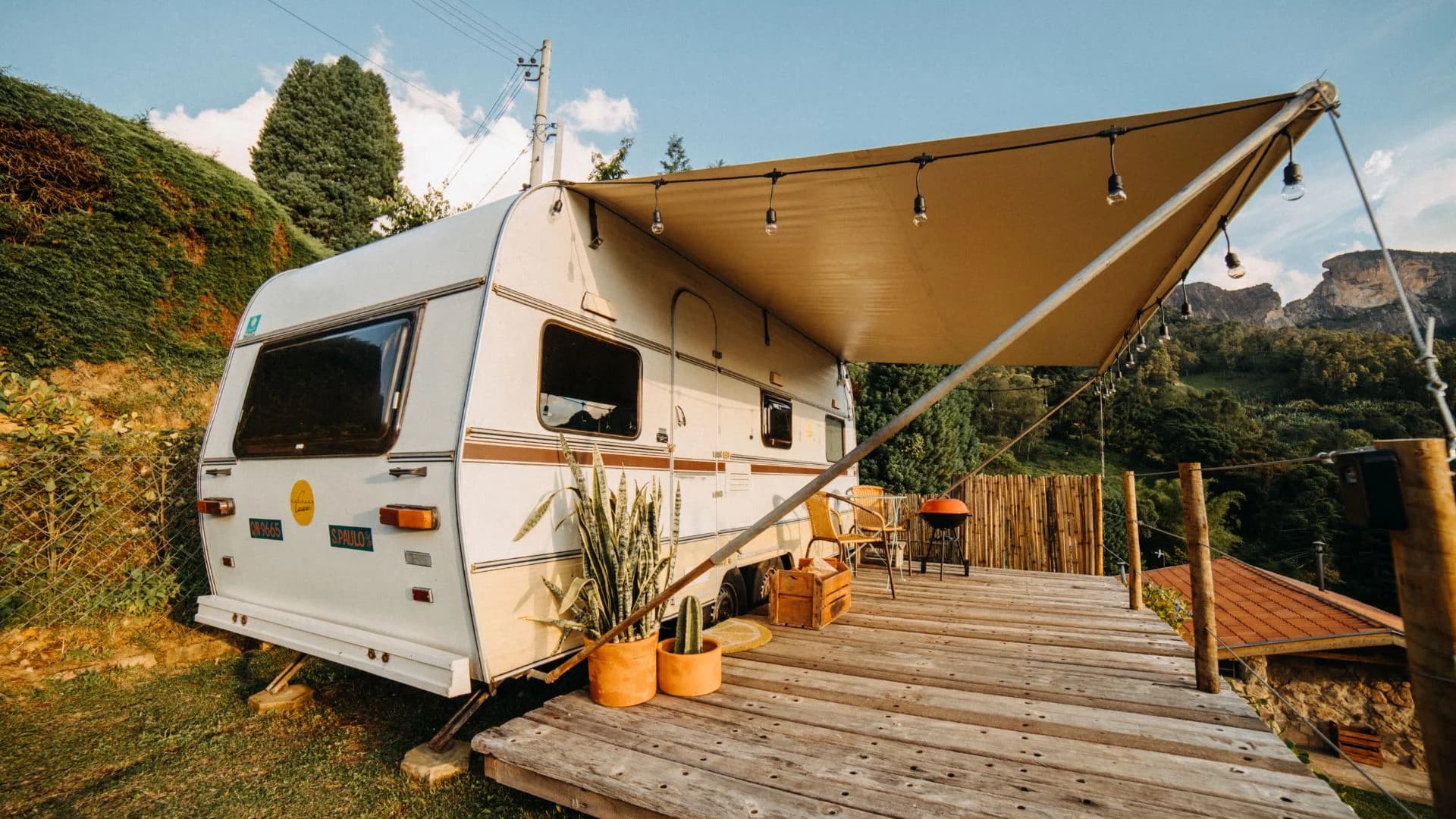
Everyone dreams about the Big Lap. Fewer people sit down and work out what it actually costs. The number that gets thrown around most is somewhere between $50,000 and $100,000 for a year on the road, and honestly, both ends of that range are right. It just depends entirely on how you travel.
This is the full version: how far the lap really is, how to time it around the seasons so you are not driving into a cyclone or a closed road, what the rig and the tow vehicle cost, what you will actually burn in fuel while towing, where you can sleep and for how much, what breaks and what it costs to fix, and the expenses that quietly wreck budgets. There are three complete 12-month budgets at the end.
The Short Answer
Most full-time travellers land somewhere between $1,000 and $1,500 a week once everything is counted. Tight budgets sit closer to $500 to $800. Travelling comfortably, staying in parks most nights and doing the big-ticket tours, pushes past $2,000.
| Travel style | Per week | Per month | Per 12 months |
|---|---|---|---|
| Budget, mostly free camping, slow pace | $500 to $850 | $2,200 to $3,700 | $28,000 to $44,000 |
| Mid-range, mixed camps and parks | $1,000 to $1,500 | $4,300 to $6,500 | $52,000 to $78,000 |
| Comfortable, parks most nights, tours | $2,000+ | $8,700+ | $104,000+ |
Those figures exclude the caravan and the tow vehicle. Buy those and you can add anywhere from $25,000 to well over $200,000 to the picture. We break the rig down further below.
How Far Is the Big Lap, and How Long Does It Take?
Highway 1 is the ring road around the country and it runs roughly 14,500 km. Add the detour up to Darwin and you are already past 15,500 km before a single side trip. In practice, almost nobody drives just the ring. Once you factor in national parks, backtracking, the Red Centre, Tasmania and the days you drive 200 km the wrong way because someone told you about a beach, most Big Lappers finish somewhere between 25,000 and 30,000 km.
Pace is the single biggest lever you have on cost, and it works on two things at once. Driving less burns less fuel, and staying put longer unlocks the weekly and monthly rates at caravan parks instead of paying by the night.
| Pace | Time on the road | Typical distance | What it feels like |
|---|---|---|---|
| Flat out | 6 to 8 weeks | 15,000 to 18,000 km | One or two nights per stop, most days spent driving. Cheap on camp fees, brutal on fuel and on you. |
| Fast | 3 to 4 months | 18,000 to 25,000 km | The realistic minimum if you want to actually see things. Long driving days, little downtime. |
| Classic 12-month lap | 10 to 14 months | 25,000 to 30,000 km | Three to seven nights per stop, seasons timed properly, room to stop when somewhere is worth it. |
| Slow lap | 18 months to indefinite | 10,000 to 20,000 km per year | Weeks in one spot, weekly and monthly park rates, lowest weekly cost of all. |
Counter-intuitively, the slowest travellers usually have the lowest weekly spend. Fuel and camp fees are what a hurry costs you.
When to Go: You Are Chasing the Seasons, Not the Map
This is the part that separates a good lap from a miserable one, and it has real cost consequences. Australia is too big to have one travelling season. The north runs on wet and dry, the south on summer and winter, and they are opposites.
Northern Australia has a wet season from roughly November to April: heat, humidity, flooding, road closures and cyclones. The dry season from May to October is why everyone heads north in winter. The southern states flip it, with summer between December and February being the window for Tasmania, the Victorian and South Australian coasts, and the alpine country.
| Season | Where to be | Why |
|---|---|---|
| Summer (Dec to Feb) | Tasmania, Victoria, South Australia, southern NSW coast | Mild southern weather and long days. Peak school-holiday pricing, so book early. |
| Autumn (Mar to May) | Nullarbor crossing, WA Coral Coast, Ningaloo, Karijini | One of the best windows to cross the Nullarbor. Milder heat and fewer crowds before winter. |
| Winter (Jun to Aug) | The Kimberley, Broome, Darwin, Kakadu, Litchfield, the Red Centre | The dry season. Roads open, humidity low, everything accessible. Also the busiest and priciest time up north. |
| Spring (Sep to Nov) | Queensland coast, Cape York, the reef | Shoulder season on the east coast. Cape York opens up before the wet returns. |
Some access windows are hard limits, not preferences. The Gibb River Road is generally only open from around May to October. Cape York is usually driveable from about June through to November, depending on how the wet finishes. Crossing the Nullarbor in mid-summer is legal but punishing on a towing vehicle. Plan around these first and fit everything else in behind them.
Clockwise or Anticlockwise?
There is no universally right answer. It depends on where you live and when you can leave. If you are starting from Victoria, South Australia or NSW around October or November, going clockwise (west across the Nullarbor first, then north through WA) lines you up with the Kimberley in the dry. If you are leaving from Queensland or northern NSW around April or May, anticlockwise gets you into the Top End at the right time. The rule of thumb is simple: leaving in winter, head north; leaving in summer, head south.
One cost note. Travelling in step with the seasons means you arrive in each region during its peak, so book caravan parks well ahead and expect peak pricing. Travelling against the flow is cheaper and quieter, but you are trading that for heat, closures and, in the north, genuine safety risk.

The Rig: What a Caravan or Camper Actually Costs
Before you have covered a single kilometre, the van is usually the biggest single number in the whole exercise.
| Type | Indicative price | Suits |
|---|---|---|
| Camper trailer | $15,000 to $35,000 | Couples happy to set up and pack down, tight budgets, rough tracks |
| Pop-top caravan | $35,000 to $55,000 | Lower towing weight and height, easier on fuel, less internal space |
| Hybrid / off-road camper | $45,000 to $85,000 | Serious off-road access with hard-sided comfort |
| Full-size family caravan | $55,000 to $95,000 | Bunks, ensuite, long stays, sealed and good gravel roads |
| Premium off-road tourer | $95,000 to $150,000+ | Full off-grid capability, remote touring, extended free camping |
| Motorhome | $90,000 to $250,000+ | No towing, but you pack up the whole house every time you go for milk |
The second-hand market is worth a serious look. A three to five year old van has already taken the steepest depreciation hit, and vans that have lived under cover often present far better than their age suggests. Have any used van professionally inspected for water ingress and delamination before you hand over money. It is the single most expensive fault to discover later.
The Weight Trap That Catches Almost Everyone
Roadside weigh-ins keep finding a large share of rigs are over their legal limits, usually without the owner having any idea. Being overweight is not a technicality: it can void an insurance claim after an accident, and it changes how the rig behaves in an emergency stop.
- ATM (Aggregate Trailer Mass): the maximum weight of the loaded van. This is the number that must sit under your vehicle’s braked towing capacity.
- GTM (Gross Trailer Mass): what the van’s own axles carry, so ATM minus the ball weight.
- GVM (Gross Vehicle Mass): the maximum loaded weight of the tow vehicle itself, including passengers, fuel, gear and the ball weight pressing down on the towbar.
- GCM (Gross Combined Mass): the maximum for car and van together. This is the one that catches people, because GCM is often less than GVM plus towing capacity. You cannot always max out both at once.
- Ball weight: typically around 10% of the loaded van, and it eats directly into your vehicle’s payload.
Un-braked towing is legally capped at 750 kg in Australia. Braked capacity runs from about 2,300 kg to 3,500 kg depending on the vehicle. The only way to know your real numbers is to load the rig exactly the way you will travel, with full water and full fuel, and run it over a public weighbridge or book a mobile caravan weighing service. Do this before you leave, not after something goes wrong.
The Tow Vehicle
For most Big Lappers the tow vehicle is either an existing 4WD or a separate purchase, and it deserves as much thought as the van. Three things matter more than badge loyalty: enough braked towing capacity for your van’s ATM, enough payload left over after the ball weight to carry your family and gear, and a GCM that lets you run both loaded at once.
Diesel dominates for a reason. Torque low in the rev range makes towing easier, and range between fills matters when the next roadhouse is 300 km away. A bigger vehicle gives you weight headroom and towing stability but costs you at every fuel stop, which is the real trade-off rather than any argument about brands.
If you're financing the tow vehicle as well as the van, it is worth comparing loan structures properly rather than defaulting to dealer finance. Our car loan interest rates guide breaks down how to compare offers before you sign anything, and if the tow vehicle is going to be a second-hand buy, our used car buying tips are worth a read first.
Fuel: The Biggest Single Running Cost
Fuel is typically the largest line in a Big Lap budget, and the timing matters right now. The temporary excise relief stepped down to 36.6 cents a litre on 1 July 2026 and ended entirely on 3 August 2026, reverting to the full indexed rate of roughly 52.6 cents a litre on both petrol and diesel. If you are pricing a lap for the rest of this year, budget on pump prices sitting noticeably higher than what you saw through winter.
Then there is the towing penalty. Hitching up a two to three tonne box with the aerodynamics of a shipping container typically adds 30% to 60% to your consumption. Here is roughly what to expect, with the fuel cost worked at $2.20 a litre.
| Tow vehicle | Solo | Towing | Fuel per 10,000 km towing |
|---|---|---|---|
| Mid-size 4WD wagon (Prado, Everest, Pajero Sport) | 9 to 10 L/100km | 13 to 16 L/100km | $2,860 to $3,520 |
| Dual-cab ute (Ranger, HiLux, D-Max, Triton) | 8 to 9.5 L/100km | 14 to 18 L/100km | $3,080 to $3,960 |
| Large diesel 4WD wagon (LandCruiser, Patrol) | 11 to 13 L/100km | 18 to 24 L/100km | $3,960 to $5,280 |
| Large petrol 4WD wagon | 14 to 16 L/100km | 22 to 28 L/100km | $4,840 to $6,160 |
Real-world tow tests back this up. A Prado towing a 2,300 kg van has been recorded at about 13.4 L/100km, while a 200 Series pulling 2,650 kg sat at around 23.5 L/100km against 12.6 solo. Your number depends far more on weight, speed and headwind than on the badge.
Remote pricing is the other half of the story. Roadhouse diesel regularly runs $2.50 to $3.00 a litre, and travellers report paying close to $2.89 in places like Tom Price. Fill up in regional centres rather than isolated stops wherever the range allows, and consider a long-range tank or jerry cans for the genuinely remote legs.
- Dropping from 100 km/h to 90 km/h while towing is the cheapest fuel saving available to you, and it is usually worth 1 to 2 L/100km.
- Correct tyre pressures for the load and surface matter more than most people think.
- Anything on the roof costs you fuel all day, every day. Pack heavy gear low and inside.
- Over a year, slow travellers doing around 10,000 km spend roughly $5,000 to $7,500 on fuel. Fast travellers covering 30,000 km or more spend $12,000 to $20,000.

Where You Sleep
Accommodation is the lever that moves your weekly spend more than anything except pace. There are really four tiers, and almost everyone mixes them.
| Style | Typical cost | Per week | Notes |
|---|---|---|---|
| Free camps and rest areas | $0 to $20 per night | $0 to $140 | Needs a self-sufficient rig: water, power, and often your own toilet |
| National park campgrounds | $7 to $30 per night | $50 to $210 | Charged per person in most states. Book ahead in peak season |
| Budget and inland caravan parks | $35 to $50 per night | $250 to $350 | Powered site, showers, laundry, dump point |
| Coastal and peak-season parks | $80 to $120+ per night | $560 to $840+ | School holidays, Easter, and 20 Dec to 31 Jan are the worst of it |
National park fees vary by state and are usually per person, per night. Queensland charges $7.75 per person or $31.00 per family per night. Western Australia charges per person per night and sells holiday passes running from five days to four weeks, which pay for themselves quickly if you are spending a season in the west. The Northern Territory tiers its fees by how developed the campground is, and Queensland takes bookings online in advance.
A realistic blended average for most travellers is $250 to $400 a week. Travellers who free camp most nights report $100 to $250 a month. A 50/50 mix of free and paid sites runs $600 to $1,000 a month. Staying in caravan parks full-time is $1,500 a month and up. If you are going to sit somewhere for a while, always ask for the weekly or monthly rate rather than paying by the night, because the discount is often substantial.
Apps do the heavy lifting here. WikiCamps, CamperMate and Camps Australia Wide will find free and low-cost camps, dump points and drinking water between paid stays, and the reviews will tell you whether a spot is genuinely quiet or a truck stop with a view.

Food, Groceries and the Odd Counter Meal
Cooking in the van, most couples spend $150 to $250 a week on groceries. Add a takeaway or a pub meal once or twice a week and you are at $300 to $400. Eating out regularly pushes past $500.
Remote pricing is real and it stings. Expect groceries in remote communities and roadhouses to run well above city prices, sometimes 20% to 40% higher for basics, and fresh produce to be limited. The habit that saves the most money is stocking up properly in the last decent-sized town before a remote leg. If you drink, budget another $50 to $100 a week, and be aware that parts of the NT and WA have alcohol restrictions that affect what and where you can buy.
Maintenance: The Part Everyone Underestimates
Towing, corrugations and dust put both the vehicle and the van into what manufacturers call severe service conditions. That is not marketing. It genuinely halves some service intervals.
| Item | Interval on a lap | Typical cost |
|---|---|---|
| Vehicle oil and filter (severe conditions) | Every 5,000 km rather than 10,000 to 15,000 | $150 to $350 |
| Full vehicle service | Every 10,000 km or 6 months | $400 to $1,200 depending on the service |
| Air filter check and clean | After every dusty leg | $0 to $120 |
| Caravan underbody service (bearings, brakes, lights) | Every 10,000 km | $200 single axle, $300 tandem |
| Full caravan service | Annually | From around $300 |
| Wheel bearing set | Every 10,000 to 50,000 km depending on conditions | About $100 per axle set |
| Brake shoes | As needed | About $80 per axle set |
| Caravan tyres | Every 5 to 6 years, sooner on gravel | $150 to $400 each |
| Vehicle all-terrain tyres | Often once per lap | $1,200 to $2,000 for a set of five |
Corrugations are what actually destroys things. Shock absorbers, water tank straps, fridge mounts, cupboard hinges, wiring, chassis welds and anything not properly secured all suffer. Every extra kilo you carry is amplified on a corrugated road, which is another reason the weighbridge visit matters. On the Gibb River Road specifically, travellers report a spike in tyre damage from sharp shale on the eastern side, so carry two spares and a spare bearing kit if you are heading that way.
Budget $2,000 to $3,500 a year for maintenance on a well-sorted rig, $5,000 to $10,000 or more on an older one. Tyres, oil and services alone typically account for $1,500 to $3,500 of that.

Insurance, Rego, Comms and the Fixed Bills
These are the costs that keep running whether you move that week or not, which makes them easy to forget when you are working out a weekly figure.
| Cost | Typical range | Notes |
|---|---|---|
| Caravan comprehensive insurance | $250 to $500 (camper), $500 to $1,200 (mid-range van), $1,000 to $5,000+ (premium) | Average across the market sits around $560 a year |
| Vehicle comprehensive insurance | $900 to $2,000 a year | Tell your insurer you are touring full-time |
| Registration (vehicle and van) | $900 to $1,800 a year combined | Varies by state and vehicle |
| Roadside assistance / breakdown cover | About $400 a year | Check the towing distance included. Standard cover is useless 400 km from anywhere |
| Phone and data | $60 to $80 a month | Telstra still has the best remote coverage by a distance |
| Starlink Roam | $85 a month (100 GB) to $210 a month (unlimited), hardware from $549 | Worth it if you work on the road, optional if you do not |
It is worth reviewing your insurance cover before you leave rather than assuming a policy written for a van parked at home will behave the same way when it lives on gravel roads for a year.
The Upfront Setup Costs Nobody Budgets For
Between buying the rig and actually leaving, there is a gear bill. Starting from scratch, upgrades and equipment commonly run $5,000 to $15,000.
| Item | Typical cost |
|---|---|
| 200Ah lithium battery | $800 to $1,200 |
| 200 to 300W roof solar plus a portable panel | $400 to $800 |
| DC-DC charger (30 to 40A) | $250 to $400 |
| Inverter (1,000 to 2,000W pure sine) | $200 to $400 |
| Wiring, fuses, bus bars, battery monitor | $150 to $300 |
| Towing mirrors, weight distribution hitch, brake controller | $700 to $1,800 |
| Recovery gear, tools and spares kit | $800 to $2,000 |
| Portable compressor, tyre repair kit, extra spares | $400 to $900 |
| Annex, awning walls, outdoor mat and chairs | $600 to $2,500 |
| Water filtration, extra jerry cans, portable toilet | $300 to $900 |
| Weighbridge check and pre-trip service on both | $600 to $1,500 |
If you are funding that gear separately from the van itself, a personal loan is often a cleaner way to handle it than putting $10,000 of solar and recovery gear on a credit card at 20% interest.

The Costs That Actually Blow the Budget
Ask anyone who has finished a lap what went wrong financially and almost nobody says fuel. It is the unplanned stuff, and it is worth knowing what it looks like before it happens to you.
- Waiting for parts in a small town. A blown wheel bearing might be an $800 repair. The three weeks in a caravan park while the part comes from Perth is the expensive bit.
- Windscreens and stone chips. Road trains and gravel are hard on glass. A replacement runs $400 to $900, and plenty of policies carry an excess that makes small chips your problem.
- Tyres you did not plan on. A shredded van tyre plus a damaged rim on sharp shale is $400 to $700 in one hit, and you will want to replace the spare immediately afterwards.
- Water damage and delamination. Often invisible until it is not. Repairs regularly run into the thousands and can take a van off the road for weeks.
- Freight to remote towns. Getting a part to a remote community can cost more than the part itself, and it is rarely quick.
- Medical and dental. A specialist appointment can mean a flight or a long drive back to a capital city, plus accommodation while you are there.
- The Spirit of Tasmania. Vehicle plus caravan plus passengers is a four-figure round trip in peak season, and it books out months ahead.
- Tours at the big-ticket stops. Kakadu, Ningaloo, the Kimberley and the reef are why you came, but a single day tour is commonly $150 to $300 a head.
- The small stuff that adds up. Laundry, showers, dump point fees, drinking water, gas bottle swaps and replacement camp gear quietly run to $40 to $80 a week.
- The house you left behind. Storage, rates, insurance, property maintenance and someone to mow the lawn all keep running while you are away.
- Income you are not earning. For anyone not yet retired, this is usually the largest real cost of the whole trip and the one least often written down.
- The "we have had enough" fund. A few nights in a motel after a rough week, or a last-minute flight home for a family emergency. It happens on most long laps.
The consistent advice from people who have done it: set aside $5,000 to $8,000 as a genuine contingency for a 12-month lap, and do not touch it for anything you could have predicted. Travellers who did this describe it as the best decision they made. Travellers who did not are the ones who came home early.

Three Realistic 12-Month Budgets
Here is everything above pulled into three complete annual budgets for a couple, excluding the purchase of the rig and the tow vehicle.
| Category | Budget | Mid-range | Comfortable |
|---|---|---|---|
| Fuel | $8,000 | $11,000 | $15,000 |
| Accommodation and camp fees | $7,000 | $15,000 | $28,000 |
| Groceries | $10,500 | $13,000 | $15,500 |
| Eating out and drinks | $3,000 | $6,000 | $12,000 |
| Vehicle and van maintenance | $4,000 | $5,500 | $8,000 |
| Insurance and registration | $2,800 | $3,500 | $4,500 |
| Phone and internet | $1,200 | $2,400 | $3,000 |
| Activities, tours and park passes | $2,500 | $5,500 | $12,000 |
| Contingency | $5,000 | $6,500 | $8,000 |
| Annual total | $44,000 | $68,400 | $106,000 |
| Equivalent per week | $846 | $1,315 | $2,038 |
Your own number will land somewhere across this spread depending on pace, rig and how much you are genuinely willing to free camp. The categories matter more than the totals: if you know which line you are prepared to squeeze, you can hold a budget. If you do not, you will drift toward the right-hand column without noticing.
Five Ways to Cut the Cost Without Ruining the Trip
- Slow down. It is the biggest lever by a distance and it works on fuel and camp fees at the same time. Three nights per stop instead of one can cut a weekly budget by hundreds.
- Free camp properly. Every free night is $40 to $60 back in your pocket, but it only works if the rig is genuinely self-sufficient on water, power and waste. That is what the solar and battery spend buys you.
- Buy the annual park passes. If you are spending a season in Western Australia or Tasmania, a park pass pays for itself in a fortnight.
- Travel the shoulders. Arriving a few weeks either side of school holidays changes caravan park pricing dramatically, without pushing you into the wet season.
- Work as you go. Workforce Australia now runs the harvest job search that replaced the old Harvest Trail service, and it maps seasonal work by region and crop right around the country. Many harvest and station jobs include a free or discounted powered site. Caravan park hosting, hospitality and house sitting all work the same way. Even a few weeks of work a year meaningfully changes the maths.

Financing the Rig Without Draining Your Savings
Plenty of Big Lappers finance the caravan rather than draining savings or superannuation to buy it outright, particularly when they plan to keep travelling year to year rather than doing a once-off trip. A caravan consumer loan spreads the upfront cost into fixed repayments, which for a lot of couples makes more sense than tying up the bulk of their retirement savings in a depreciating asset before they have even left the driveway. It also leaves the contingency fund intact, which matters more on a lap than almost anything else.
Our team compares 30+ lenders across the full range of caravan and RV finance options, so you can see what fits your situation before you commit. You can also run the numbers yourself to get a feel for the repayments before you speak to anyone.
Key Takeaways
- Highway 1 is about 14,500 km, but most Big Lappers cover 25,000 to 30,000 km once side trips are counted.
- Time the lap around the seasons first, then plan everything else. The Gibb River Road and Cape York have hard access windows.
- The rig is the biggest single cost, from $15,000 for a camper trailer to $150,000+ for a premium off-road tourer.
- Weigh the loaded rig at a weighbridge before you leave. Being over GCM can void an insurance claim.
- Towing adds 30% to 60% to fuel consumption, and excise reverted to the full indexed rate on 3 August 2026.
- Accommodation style is the single biggest lever on weekly spend, and pace is the second.
- Severe-conditions servicing means oil changes at 5,000 km and a caravan underbody service every 10,000 km.
- Set aside $5,000 to $8,000 as untouchable contingency. It is the difference between finishing the lap and coming home early.
- Financing the caravan rather than draining savings is a common and sensible approach, and it keeps your cash buffer where you need it.
Big Lap FAQs
How much should I have saved before I leave?
Beyond the rig, plan on a full year of your chosen budget plus the $5,000 to $8,000 contingency. Leaving with only enough for the travel itself is the most common reason laps end early.
Can you do the Big Lap on the pension?
People do, and the way they manage it is by travelling slowly, free camping most nights and staying put for weeks at a time. It looks nothing like a 12-month lap and everything like a slow, indefinite one.
Do I need a 4WD?
Not for the sealed ring road. You do for the Gibb River Road, Cape York, most of the good free camps and a lot of the national parks that make the trip worth doing. Most people who start in a 2WD end up wishing they had not.
How much power and water do I need to free camp?
As a rough guide, 200Ah of lithium with 300W of solar and around 150 litres of water will keep a couple comfortable off-grid for four to seven days. Less than that and you will be paying for powered sites more often than you planned.
What is the biggest mistake people make?
Two, and they are related. Buying more van than the tow vehicle can legally and comfortably pull, and trying to see the whole country in six months. Both are expensive, and the second one is why people come home saying it was exhausting.
Thinking about financing your caravan or tow vehicle for the trip? Call 1800 079 147 or get in touch online and we'll compare 30+ lenders to find the right rate for your situation.
Sources referenced: Australian Taxation Office, Excise duty rates for fuel and petroleum products; Queensland Department of Environment, Tourism, Science and Innovation, camping fees; Explore Parks WA, camping fees; NT Government, park camping fees; and the Workforce Australia harvest job search. Cost ranges also draw on published Big Lap budgets from long-term Australian travellers and industry servicing and insurance guides.
This article provides general information only. It does not constitute financial advice. Please consider your personal circumstances before making any financial decisions. Loans123 holds Australian Credit Licence 512846.
Ready to see what you could borrow?
Loans123 compares more than 30 lenders from our Victoria Park office in Perth. Read more about our Caravan & RV Loans and Travel Loans, or get a quote now.
Checking your options has no impact on your credit score.
Written by

Trent Cray
Finance Specialist, Loans 123
Trent is a Finance Specialist at Loans 123 in Victoria Park, Perth. He helps customers compare more than 30 lenders to find car, personal and business finance that suits their situation.
Meet the Loans 123 team